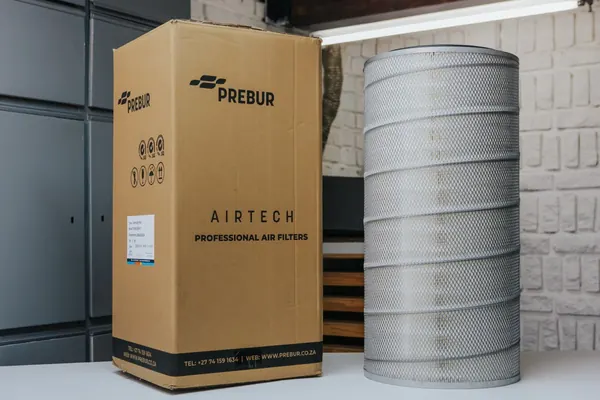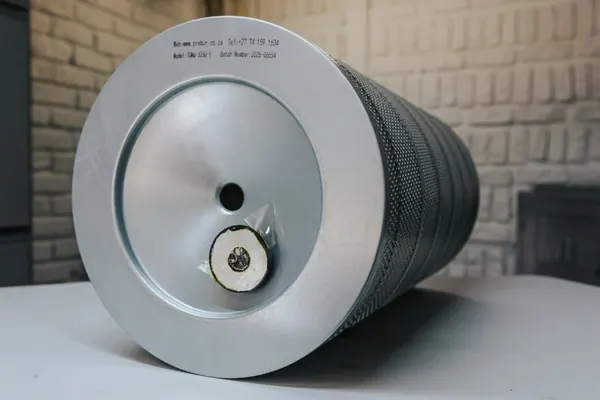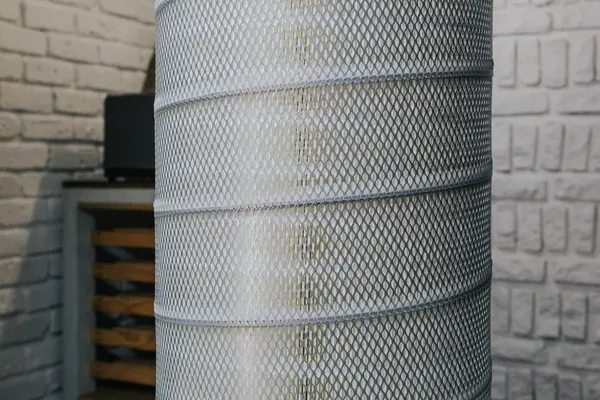
A customer asked us this: why is there a steel mesh wrapped around the outside of the cartridge, and another one inside? It is a good question. The short answer is that the mesh is what keeps the pleats in shape. Whether you need it depends on what the filter is made of.
How a Cartridge Is Built
A dust collector cartridge is a pleated filter tube. Dusty air passes from the outside in. Dust stays on the outside of the pleats, and clean air leaves through the open top.
It has four main parts:
- Media: the pleated filter material. It decides which dust the filter suits.
- Outer support: a mesh or wrap around the outside of the pleats. Some cartridges have none.
- Inner mesh (the core): a steel tube inside the pleats.
- End caps and seal: these make the cartridge fit and seal in your housing.
The mesh may be galvanised steel or stainless steel. Some cartridges use a wire or thread wrap instead of an outer mesh.
Why the Outer Mesh Is There
In a pulse-jet dust collector, the cartridges clean themselves. A short blast of compressed air is fired down the inside of the cartridge every few minutes. The pulse flexes the pleats outward and knocks the dust off into the hopper below.
Our stocked Airtech cartridge uses cellulose media. Cellulose is a plant fibre, and it is soft. On its own, it would not keep its shape under the pulse. The outer mesh holds the pleats in place each time the pulse hits. Without it, the pleats deform and the filter fails early.
Why the Inner Mesh Is There
The inner mesh does the opposite job. While the collector runs, the fan pulls air in through the pleats towards the middle of the tube. That pull pushes the pleats inward. The inner mesh, or core, stops them collapsing.
Every cartridge has an inner mesh. Even a cartridge without an outer mesh still has one.
The Meshless Option
Cartridges without an outer mesh exist. They are made in spunbond polyester, a synthetic media that is stiff enough to hold its pleats on its own. We supply them made to order, so they are quoted, not held in stock.
Spunbond polyester has a different character from cellulose. It is strong, and dust comes off it easily. It holds much less dust in its depth than cellulose does, and for some jobs that is the point: less powder stays trapped in the filter. A PTFE membrane option (a thin film on the polyester that keeps fine dust on the surface) is also available for very fine powder.
The trade-off is price. Polyester cartridges cost more than cellulose.
Which One Suits Your Job
The stocked cellulose cartridge, with mesh, suits dry dust that is not sticky, at room temperature, and not combustible. Typical jobs:
- Compressor, blower and generator set air intakes in dry conditions.
- Grinding and cutting dust in metal fabrication.
- Shot blast and sandblast reclaim dust.
- Dry mineral powders that do not burn.
- Small powder coating booths that spray to waste (throw overspray away rather than recover it).
Meshless polyester, made to order, suits:
- Powder coating booths that recover powder or change colour often. Powder blows off cleanly, and far less is left in the filter between colours.
- Damp or moisture-absorbing dust such as cement, fertiliser and sugar. Cellulose soaks up moisture and clogs.
- Welding, laser and plasma fume, usually with a PTFE membrane, because fume is very fine and sticky.
Combustible dust, such as wood, flour and some metal dusts, needs antistatic media. Your site safety assessment decides that specification.
When to Replace It
Mesh or no mesh, a cartridge is a consumable. Go by the pressure gauge on the collector. Our stocked cartridge starts at a maximum of 160 Pa when new. Replace it at 900 Pa, once pulse cleaning no longer brings the reading back down.
Bent, collapsed or torn pleats at change-out are worth noting. So is a damp, crusty surface. Both can mean the cartridge is wrong for the job. Our post on why dust collector cartridges fail early covers the signs.
How to Order
We stock two Airtech cartridges at our Silverton warehouse: L600 × OD324 mm and L660 × OD324 mm, cellulose media manufactured to EN779 F6, with a galvanised top cap and inner and outer mesh. See the cartridge filters page.
For a meshless polyester cartridge, or any other size, send Nick the part number off your old cartridge (or a photo of the label and both ends), the size in mm, the make and model of your collector, and what dust it handles. He will quote it.
Not sure which cartridge you need? Call Nick Els on +27 74 159 1634 or get a quote.
Frequently Asked Questions
Why does my cartridge filter have a steel mesh on the outside?
Because the media is cellulose, which is soft. The outer mesh holds the pleats in shape every time the cleaning pulse hits them. Without it, the pleats bend out of shape and the filter fails early.
What does the inner mesh do?
The inner mesh, or core, stops the pleats collapsing inward while the fan pulls air through the filter. Every cartridge has one, with or without an outer mesh.
Can I get a cartridge without the outer mesh?
Not our stocked cellulose cartridge. Cartridges without an outer mesh are made in spunbond polyester, which is stiff enough to hold its pleats on its own. They are made to order, so we quote them.
Is a meshless cartridge better?
For some jobs. Meshless polyester releases fine powder cleanly, which suits powder coating booths that recover powder or change colour often. For compressor and blower intakes and dry, light dust, the stocked cellulose cartridge with its outer mesh does the job.
Can I take the mesh off my cellulose cartridge?
No. The mesh is part of what keeps soft cellulose pleats in shape under the pulse. Take it away and the pleats deform. If you want a meshless filter, it needs to be a polyester cartridge made for it.
Need help choosing the right filter?
Speak to Nick Els for expert advice on filter selection, cross-referencing, and pricing for your facility.